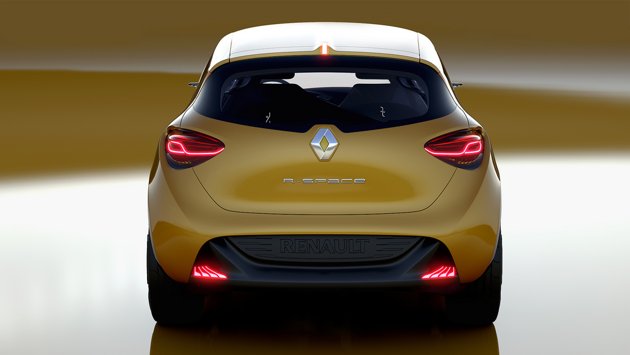
R-Space, unveiled at the 2011 Geneva Motor show, represents the "Family" stage in the company’s new life-cycle Design strategy.
With a silhouette that is both sporty and sculptural and a playful interior, R-Space proves that a MPV can be cunning and innovative.
It is also environment-friendly, as it is powered by a petrol concept engine that previews the new range of modular TCe engines, Energy TCe, that will be launched by Renault in 2012
Third phase of Laurens van den Acker's Design strategy, R-Space is a simple, sensuous and welcoming family vehicle. It also draws back to the sensuality of the first concept car of the cycle of life, DeZir.


With a silhouette that is both sporty and sculptural and a playful interior, R-Space proves that a MPV can be cunning and innovative.
It is also environment-friendly, as it is powered by a petrol concept engine that previews the new range of modular TCe engines, Energy TCe, that will be launched by Renault in 2012
Third phase of Laurens van den Acker's Design strategy, R-Space is a simple, sensuous and welcoming family vehicle. It also draws back to the sensuality of the first concept car of the cycle of life, DeZir.

This family car features double doors which, unobstructed by any central pillar, give clear access to a spectacular interior designed to trigger strong emotions from the very first glance, and a feeling of space and openness.
The theme being that of the family, it was the image of the family Sunday breakfast that provided the inspiration for R-Space’s colours and materials. The tenderness and warmth of these shared moments
find their expression in tones that are warm and "sweet".
The tapered profile of the side windows emphasises the dynamic profile, while the large windscreen and panoramic roof – the thickness of which gradually changes – transform the passenger compartment into a cosy cocoon of shade.
Different views in beautiful R-SPACE CAR


The Energy TCe Concept engine offers technologies such as direct fuel-injection, radio-frequency spark plugs, an Exhaust Gas Recirculation Boost system, a pulse Stop&Start system – and even a variable-displacement oil pump.
Its reduced CO2 emissions have been kept to only 95g/km, equivalent to a fuel consumption of only 3.7 litres/100km, without sacrificing performance.
R-Space is powered by the Energy TCe Concept engine. Packed with advanced features, this direct-injection petrol engine previews the new range of modular TCe engines that Renault will launch onto the market in 2012
- Third phase of Laurens van den Acker's Design strategy, R-Space is a simple, sensuous and welcoming family vehicle. It also draws back to the sensuality of the first concept car of the cycle of life, DeZir.
- This family car features double doors which, unobstructed by any central pillar, give clear access to a spectacular interior designed to trigger strong emotions from the very first glance, and a feeling of space and openness.
- The theme being that of the family, it was the image of the family Sunday breakfast that provided the inspiration for R-Space’s colours and materials. The tenderness and warmth of these shared moments find their expression in tones that are warm and "sweet".
- The tapered profile of the side windows emphasises the dynamic profile, while the large windscreen and panoramic roof – the thickness of which gradually changes – transform the passenger compartment into a cosy cocoon of shade.
- The nose of R-Space adapts the new visual identity (centred on the large, vertically-oriented Renault lozenge), already used on DeZir and Captur.
- Third phase of Laurens van den Acker's Design strategy, R-Space is a simple, sensuous and welcoming family vehicle. It also draws back to the sensuality of the first concept car of the cycle of life, DeZir.
- This family car features double doors which, unobstructed by any central pillar, give clear access to a spectacular interior designed to trigger strong emotions from the very first glance, and a feeling of space and openness.
- The theme being that of the family, it was the image of the family Sunday breakfast that provided the inspiration for R-Space’s colours and materials. The tenderness and warmth of these shared moments find their expression in tones that are warm and "sweet"
- This family car features double doors which, unobstructed by any central pillar, give clear access to a spectacular interior designed to trigger strong emotions from the very first glance, and a feeling of space and openness.
Comments
Post a Comment